
- YesTrades - Your Trusted Partner
- June 23, 2026
- Safety Guides
Gas Safety Certificate Landlord Guide 20...
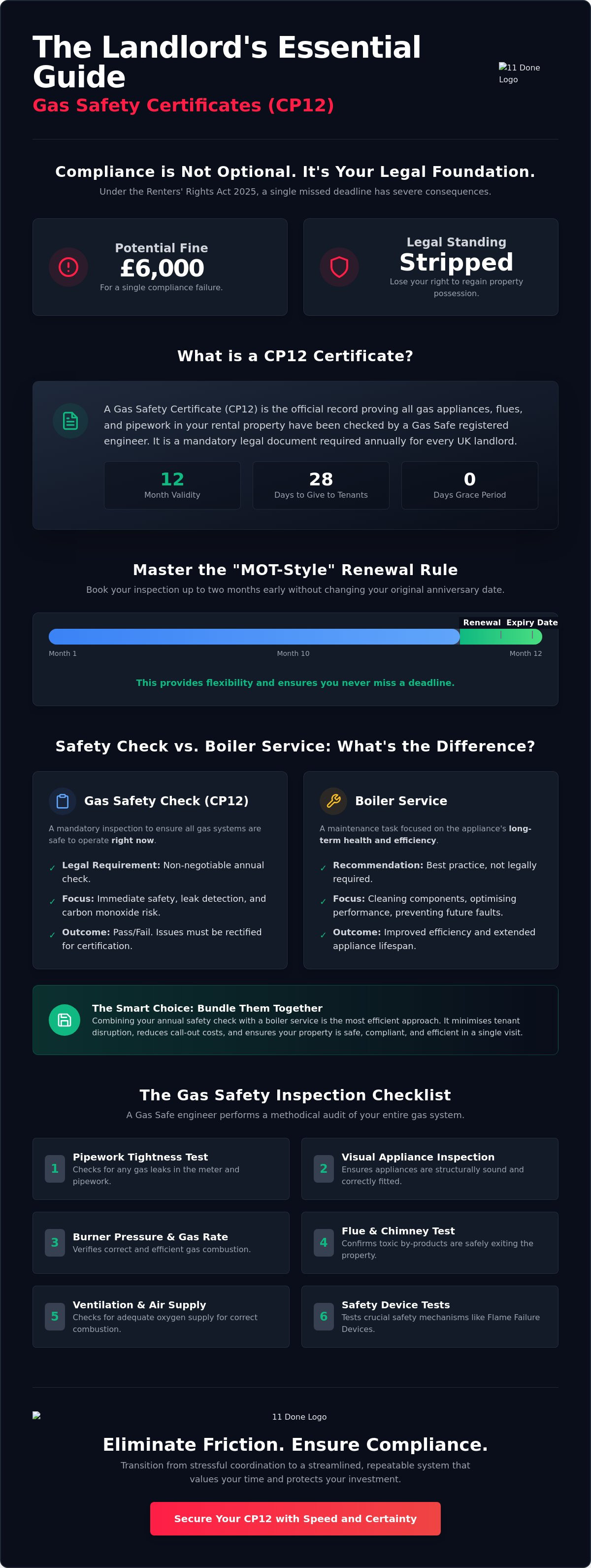
A single missed deadline can cost you £6,000 in fines and strip away your legal right to regain possession of your property. Under the Renters' Rights Act 2025, compliance isn't just a safety box to tick. It is the foundation of your legal standing as a property owner. We know the drill. You're tired of opaque pricing from local tradespeople and the constant hassle of coordinating engineers with tenant schedules.
It's time to simplify. Securing a gas safety certificate landlord record shouldn't be a struggle. This guide offers a pragmatic path to securing your CP12 efficiently whilst ensuring total legal compliance for your rental property. We've stripped away the jargon to focus on what matters: safety, speed, and reliability. You want a valid certificate in hand and a safe home for your tenants without the friction.
We will walk you through the current 2026 regulations, the benefits of bundling boiler services, and a streamlined process for repeatable annual renewals. Get your compliance sorted. Keep your tenants safe. Protect your investment with a process that actually works.
Key Takeaways
- Master the "MOT-style" renewal rule. Book your inspection up to two months early whilst keeping your original anniversary date intact.
- Identify the critical steps in a professional safety check. We outline everything from pipework tightness tests to structural appliance inspections.
- Choose the right pricing model. Learn why fixed-fee services offer the certainty you need for a gas safety certificate landlord portfolio.
- Protect your legal standing. Ensure your CP12 remains valid under current regulations to avoid voiding your insurance or facing severe penalties.
- Eliminate booking friction. Transition from stressful engineer coordination to a streamlined, repeatable system that values your time.
What is a Gas Safety Certificate (CP12) for Landlords?
The CP12 is the official record of your annual gas safety check. It is the single most important document in your compliance folder. Under the Gas Safety (Installation and Use) Regulations 1998, this check is mandatory for every UK landlord. It isn't just about the boiler. The inspection covers every gas appliance you own, the flues that vent them, and the pipework that connects them. It is your proof that the gas system in your rental property is fit for purpose and safe for habitation.
Understanding What is a Gas Safety Certificate (CP12) involves more than just holding a piece of paper. It is a rigorous safety audit. A Gas Safe registered engineer must visit the property once every 12 months. They verify that gas is burning correctly. They check that harmful fumes are being removed safely. They ensure all safety devices are working as intended. A valid gas safety certificate landlord record is your shield against liability and your primary proof of a safe rental environment. It lasts for exactly 12 months from the date of issue. Not a day longer.
Legal Requirements and the 12-Month Rule
Compliance follows a strict timeline. You must provide a copy of the new certificate to your existing tenants within 28 days of the inspection. For new tenancies, the rules are even tighter. A valid copy must be handed over before the tenant moves in. Failure to do this doesn't just put lives at risk. It puts your freedom and finances on the line. Penalties include unlimited fines and potential imprisonment for serious breaches. Without a valid certificate, you cannot legally issue a Section 21 notice to regain possession of your property. The 12-month rule is absolute. However, you can now utilise the "MOT-style" rule to renew up to two months early without losing your original anniversary date.
The Difference Between a Service and a Safety Check
Many owners confuse these two distinct tasks. A gas safety check is a legal requirement focused on immediate safety. It determines if an appliance is safe to operate right now. It checks for leaks and carbon monoxide risks. A boiler service is a maintenance task. It focuses on the longevity and efficiency of the unit. During a service, an engineer cleans internal components and optimises performance. They look for wear and tear that could cause a breakdown later.
Whilst they are different, they are naturally linked. A well-maintained boiler is far less likely to fail its safety check. For a gas safety certificate landlord requirement, bundling a service with the annual check is the most efficient choice. It minimises tenant disruption. It reduces call-out costs. It ensures your property remains safe, compliant, and efficient in a single visit.
The Gas Safety Inspection Checklist: What Happens?
The inspection is methodical. Expect the process to take 30 to 60 minutes. It depends on the number of appliances in your property. Your engineer does not just look at the boiler. They follow a strict technical protocol to satisfy Landlord's Legal Obligations. Every step is designed to catch faults before they become dangerous. It is a professional audit of your entire gas system.
First, the tightness test. The engineer checks the gas meter and pipework. They ensure no leaks exist within the system. Even a minor pressure drop results in a fail. Next comes the visual inspection. The engineer looks for corrosion. They check for signs of heat stress or improper installation. Every appliance must be structurally sound and securely fitted. They then measure burner pressure and gas rate. This data is compared against the manufacturer's specifications. If an appliance burns too much gas, it is inefficient. If it burns too little, it may be incomplete combustion. Finally, the flue and chimney are tested. They must be completely clear. Combustion by-products like carbon monoxide must exit the property safely and without obstruction.
Ventilation and Air Supply Verification
Appliances need oxygen to function. Without a steady air supply, gas will not burn correctly. The engineer checks for adequate ventilation in every room containing a gas appliance. They look for blockages in air bricks. They ensure vents are not covered by dust or furniture. A flue flow test is a critical safety measure used to confirm that smoke and fumes are actually being pulled up the chimney and out of the building. This ensures no toxic gases linger inside the living space.
Safety Device Functionality Tests
Safety devices are the final line of defence. The engineer tests Flame Failure Devices (FFDs). These stop the gas flow instantly if the flame goes out. This prevents the property from filling with unburnt gas. For cookers and ovens, stability brackets are inspected. These prevent the appliance from tipping over during use. Every control is toggled. Every sensor is verified. Securing a gas safety certificate landlord record requires this level of technical detail. It is not a cursory glance. It is a deep dive into the safety of your investment. To ensure your property meets these standards without the usual trade friction, you can book a vetted professional through a streamlined platform. This keeps your gas safety certificate landlord compliance on track and your tenants protected.
Fixed-Fee vs. Hourly Rates: The Landlords Financial Choice
Hourly rates are a gamble. You don't know the final cost until the engineer packs their tools and leaves the property. This uncertainty is poison for effective property management. For a gas safety certificate landlord requirement, you need a fixed-fee model. It allows for precise budget forecasting. You can plan your annual maintenance spend down to the penny. This is especially critical for landlords managing multiple properties across the UK. It eliminates the anxiety of an open-ended invoice.
Transparency is the foundation of a reliable service. A clear fee must specify exactly what is included. Most standard homes have a boiler and a gas hob. Some include gas fires or water heaters. Ensure your quote accounts for every unit in the property. Avoid "cheap" entry-level quotes that look too good to be true. These often hide the cost of the actual certificate upload or the professional filing fee. A professional price is an all-in price. It covers the inspection, the technical checks, and the digital record.
The Value of Bundled Compliance Services
Combining your CP12 with an annual Boiler Service is a smart financial move. It slashes your overall maintenance spend. You avoid paying two separate call-out fees. It also ensures your appliances are not just safe, but running at peak efficiency. Whilst separate tasks, performing them together is the most efficient choice for busy landlords. It reduces tenant disruption to a single visit. For larger portfolios, multi-property discounts are often available. This turns compliance from a stressful chore into a streamlined, repeatable business process.
Avoiding Hidden Surcharges
Always verify if the quoted price includes VAT. Check for the official Gas Safe filing fee. Some engineers may charge extra for issuing "At Risk" or "Immediately Dangerous" labels if a fault is discovered. These labels are a mandatory part of the Gas Safety Inspection Checklist and should be included in the standard service. You shouldn't be penalised for the engineer doing their job. Professional providers like 11 Done offer flat-rate certainty. You get a clear, upfront price for standard domestic properties. No surprises. No hidden extras. Just a gas safety certificate landlord record you can trust. This level of openness is what separates a modern service from a traditional, friction-heavy trade booking.
Managing Your Renewal Timeline and Legal Obligations
Timing is everything. Missing a renewal date is a serious legal breach. Fortunately, the "MOT-style" rule provides the flexibility you need. You can book your inspection up to two months before the current certificate expires. This doesn't shorten your coverage. It preserves your original anniversary date for the following year. It gives you a 60-day window to find an engineer and coordinate with your tenants. It eliminates the last-minute panic of a looming expiry date. Proactive scheduling ensures your property never falls into a period of non-compliance.
Record keeping is equally vital. You must keep a record of every gas safety certificate landlord inspection for at least two years. In the event of a dispute or an audit, these documents are your primary defence. Digital storage is now the industry standard. Paper copies get lost or damaged. Digital files are searchable, shareable, and permanent. They allow for instant retrieval during a property sale or when setting up a new tenancy agreement. Transitioning to a digital-first approach is a simple way to modernise your property management workflow and reduce physical clutter.
Organising Access with Tenants
Access is often the biggest hurdle for landlords. Legally, you must provide at least 24 hours written notice before an engineer visits. Most tenants are happy to comply when they understand the safety benefits. Always maintain a clear paper trail of your communication. If a tenant refuses access, your logs prove you took every reasonable step to comply. Using efficient booking platforms can remove this friction entirely. They allow tenants to choose their own time slots directly. This reduces back-and-forth emails and ensures the engineer isn't met with a locked door.
Holistic Compliance: Gas, Electric, and EPCs
A CP12 is just one leg of the mandatory safety tripod. To be fully compliant, you also need a valid EICR for electrical safety and a current Energy Performance Certificate (EPC). Managing these dates separately is an administrative nightmare. Smart landlords sync their compliance schedules. By aligning your gas and electrical inspections, you reduce the number of property visits. You save time. You save on administration. You ensure that your property is always legal and ready for the market. To get ahead of your schedule and secure your compliance today, you can book your next inspection here. This proactive approach turns gas safety certificate landlord renewals from a recurring headache into a streamlined, automated process.
Securing Your CP12 with 11 Done: Speed and Certainty
Traditional trade booking is often broken. It's slow. It's unpredictable. 11 Done changes that. We provide a gas safety certificate landlord service designed specifically for the modern property owner. No more chasing engineers through endless phone calls. No more vague arrival windows that disrupt your day. We vet every Gas Safe registered engineer on our platform to ensure they meet our high standards. This ensures every check is valid. Every check is professional. You get the peace of mind that your property is safe without the usual administrative burden.
Transparency is our default setting. As discussed, price uncertainty is a major pain point for landlords. Our fixed-fee model means the price you see is the price you pay. It doesn't matter if the inspection takes longer than expected due to appliance complexity. There are no hidden surcharges for certificate filing or digital processing. This certainty allows you to manage your portfolio's maintenance overheads with total precision. Once the inspection is complete, you don't wait days for the paperwork. Instant digital certificates are delivered directly to your inbox. You can forward them to tenants or agents immediately. It is compliance at the speed of business.
Why Efficiency Matters for Modern Landlords
Efficiency is the lifeblood of a successful rental business. Fast turnaround times prevent delays in new tenancy start dates. If a property is empty, every day without a valid gas safety certificate landlord record is lost revenue. Our "no-nonsense" approach mirrors the speed of the modern rental market. 11 Done focuses on getting the job "done" without filler. We eliminate the friction so you can focus on growing your investment. We value your time as much as you do.
The 11 Done Process: Book, Inspect, Comply
The 11 Done process is built for speed and reliability. Simple online booking takes minutes, not days. You select the service, provide the property details, and we handle the rest. Automated reminders are built into our system to ensure you never miss a renewal deadline again. We track the dates so you don't have to. Professional support is also available whilst the engineer is on-site. If a technical issue arises, we are there to facilitate a solution immediately. It's a complete, end-to-end compliance system designed for the 2026 regulatory environment. Get your Gas Safety Certificate with 11 Done today.
Secure Your Property and Your Peace of Mind
Compliance is a business process. Streamline it. Use the MOT-style renewal window. Insist on fixed-fee transparency. You've seen the technical requirements. You know the legal timelines. Now, move from planning to action. A valid gas safety certificate landlord record is the foundation of a legal, safe tenancy.
11 Done offers speed. It offers certainty. Our Gas Safe Registered Engineers deliver professional results without the traditional trade hassle. Benefit from fixed-fee transparency and digital certificates delivered instantly. No surprises. No paperwork delays. Just a compliant property and a repeatable system for the future.
Book your fixed-fee Gas Safety Certificate now.
Your property is an investment. Keep it safe. Keep it legal. We're here to help you get it done.
Frequently Asked Questions
How long does a landlord gas safety certificate last?
A gas safety certificate is valid for exactly 12 months from the date of issue. You must renew it annually to remain compliant with UK law. You can utilise the MOT-style renewal rule to arrange an inspection up to two months before your current certificate expires. This allows you to maintain your original anniversary date whilst ensuring there is no gap in your legal coverage.
Is a gas safety certificate a legal requirement for landlords?
Yes, it is a mandatory legal requirement under the Gas Safety (Installation and Use) Regulations 1998. Every UK landlord must have a valid CP12 for any property with gas appliances or a gas supply. Failing to provide a gas safety certificate landlord record can lead to unlimited fines, the invalidation of your insurance, and the inability to issue a Section 21 notice to regain possession of your property.
How much does a gas safety certificate cost for a landlord?
The cost varies based on your location, the number of gas appliances in the property, and the type of building. Costs can vary significantly depending on your location within the country, with pricing often differing between urban, densely populated areas and more rural or less populated regions. Most providers charge a fixed fee for the first appliance and a smaller incremental fee for additional units like hobs or gas fires. Always ensure your quote includes the VAT and the official Gas Safe filing fee to avoid hidden surcharges.
What happens if my gas safety certificate expires?
Allowing a certificate to expire is a criminal offence. You face immediate legal liability and potential fines of up to £6,000 per property. Your landlord insurance will likely become void, leaving you unprotected in the event of an accident. Furthermore, you lose the legal right to evict tenants using standard procedures. If your certificate has expired, you must book an emergency inspection immediately to rectify the breach.
Do I need a gas safety certificate for a property with no gas appliances?
You still require a certificate if the property has a gas supply or pipework, even if no appliances are present. The engineer must perform a tightness test on the gas meter and the internal pipework to ensure there are no leaks. If the property is completely disconnected from the gas grid with no meter or pipework entering the building, a gas safety certificate landlord check is not required.
Can a tenant refuse access for a gas safety check?
Tenants can technically refuse entry, but they are often in breach of their tenancy agreement by doing so. You must provide at least 24 hours written notice before any inspection. If a tenant refuses access, you must document every attempt to contact them. Maintain a paper trail of letters, emails, and texts. This evidence proves you have taken all reasonable steps to comply with your legal safety obligations.
Does the gas safety certificate cover the boiler service?
No, a safety check and a boiler service are two distinct procedures. The safety check (CP12) is a legal requirement that confirms the appliance is safe to use right now. A boiler service is a maintenance task that involves cleaning components and optimising performance for longevity. Whilst different, most landlords choose to bundle them into a single visit to save on call-out fees and minimise tenant disruption.
How many copies of the CP12 certificate do I need?
Three parties must have access to the certificate. You must keep a copy for your own records for at least two years. Your tenant must receive their copy within 28 days of the inspection, or before they move into a new property. The Gas Safe registered engineer will also retain a copy for their files. Digital certificates are the most efficient way to manage this, as they can be instantly shared and safely backed up.
Comments