
- YesTrades - Your Trusted Partner
- June 24, 2026
- Safety Guides
Gas and Electrical Safety Check: The Lan...
Would your rental business survive a £30,000 civil penalty for a single missing document? Since the expansion of local authority powers in late 2025 and the abolition of Section 21 notices in May 2026, the margin for error has vanished. You know the pressure. Managing a property is a constant balancing act between tenant needs and shifting laws. Keeping track of your gas and electrical safety check shouldn't feel like a full-time job.
It's frustrating to juggle multiple engineer visits. Hidden costs in safety reports and confusing timelines only add to the friction. You need clarity. This guide helps you master the 2026 legal requirements. It reveals how to consolidate your inspections into one seamless process. We'll cover the specific deadlines for CP12 and EICR certificates, the latest council enforcement powers, and how a single point of contact brings order to your compliance schedule. Get the facts. Eliminate the surprises. Secure your property with confidence.
Key Takeaways
- Avoid £30,000 fines. Master the Renters' Rights Act 2025 requirements to keep your property portfolio legal and secure.
- Navigate the CP12 window. Learn how the 10-12 month rule allows you to stay compliant without losing days on your annual expiry date.
- Clarify EICR timelines. Understand the mandatory five-year rule for electrical inspections and how to handle remedial work within 28 days.
- Streamline your schedule. Booking a combined gas and electrical safety check reduces tenant disruption and halves your administrative burden.
- Get fixed-fee certainty. Use a single point of contact for transparent, no-nonsense compliance without hidden costs or surprises.
Understanding the Legal Framework for Gas and Electrical Safety
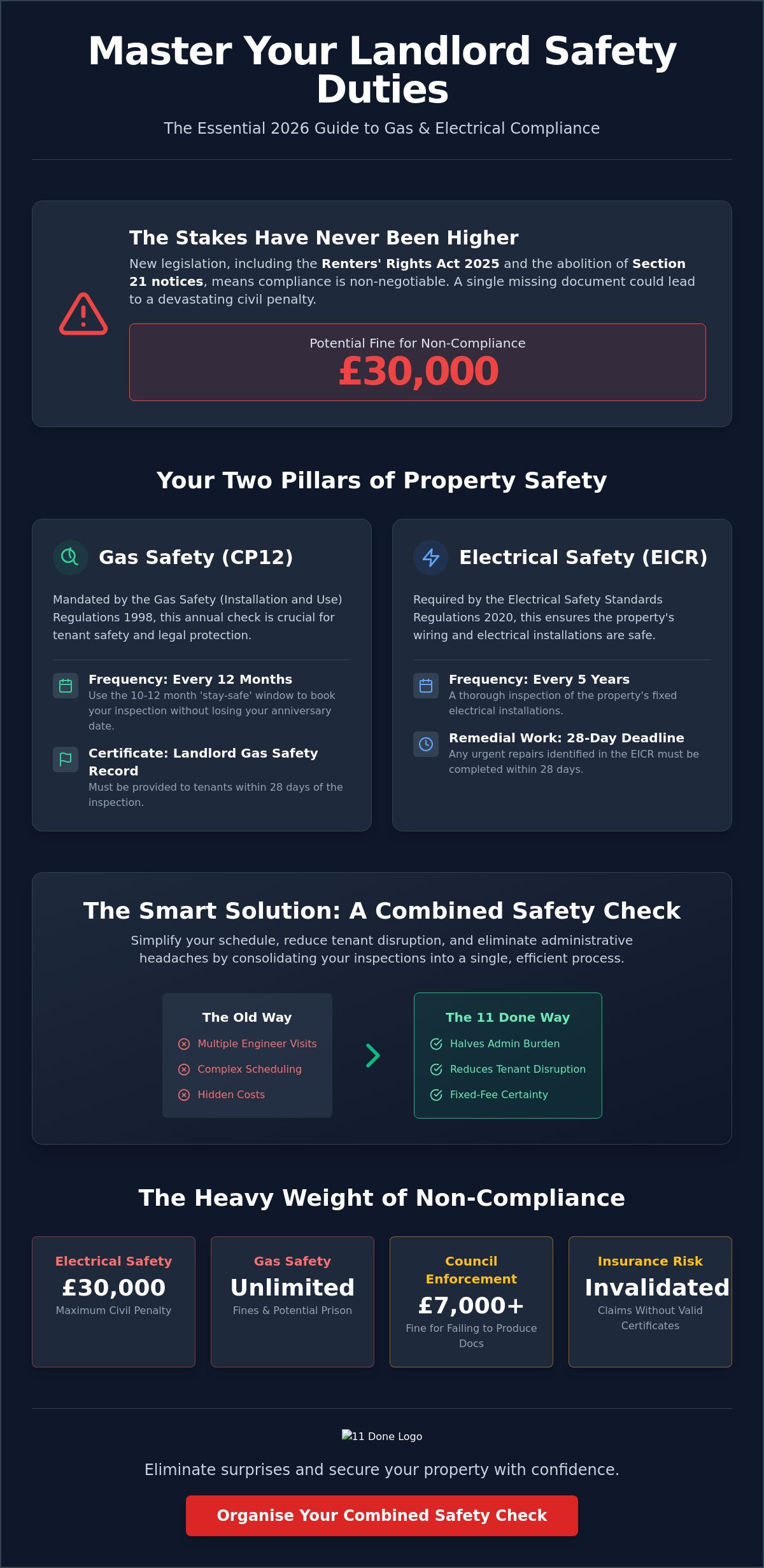
Legislation isn't a suggestion. It's the foundation of your rental business. In the UK, the legal landscape for property safety is built on two primary pillars. The Gas Safety (Installation and Use) Regulations 1998 mandate annual inspections of all gas appliances. Parallel to this, the Electrical Safety Standards in the Private Rented Sector (England) Regulations 2020 require rigorous testing every five years. These aren't just bureaucratic hurdles. They're essential protections for your tenants and your assets. In 2026, the stakes have never been higher. With the abolition of Section 21 notices under the Renters' Rights Act 2025, compliance is your only shield against legal challenges. A combined gas and electrical safety check simplifies this burden. It ensures you meet every requirement without the administrative headache.
Non-compliance carries heavy weight. For gas safety, penalties include unlimited fines and potential prison sentences. For electrical safety, local authorities can issue civil penalties of up to £30,000. Beyond the law, your insurance is at risk. Most providers will invalidate a claim if you can't produce valid safety records after an incident. Proactive maintenance isn't just about safety. It's about professional survival.
Mandatory vs Recommended Inspections
Distinguishing between "must-haves" and "best-practice" is vital. Landlords must provide a Landlord's Gas Safety Certificate to tenants within 28 days of the inspection. This is a non-negotiable legal requirement. For electricity, the EICR is mandatory. However, homeowners aren't bound by these same strict rules. Even so, safety doesn't care about tenure. Best practice suggests regular checks regardless of ownership. Local authorities now have expanded powers to enforce these standards. As of late 2025, councils can demand a full history of compliance documents. If you fail to produce them, you face fines starting at £7,000. It's no longer enough to be "mostly" compliant. You must be perfect.
Duty of Care for Landlords and Homeowners
Duty of care is your legal obligation to prevent harm. You must ensure all gas and electrical installations are in safe working order. It's about risk management. If an accident occurs, your safety record is your first line of defence. Without a valid gas and electrical safety check, you're exposed. Maintaining a clear digital paper trail is essential. Paper records are easily lost or damaged. Digital certifications are permanent and accessible. They prove you've met your obligations. They show you're a responsible landlord who values tenant safety. This transparency builds trust and protects your reputation. It keeps you out of court and keeps your property profitable.
The Gas Safety Check: CP12 Requirements and Procedures
A Gas Safety Certificate, commonly known as a CP12, is the legal proof that your property's gas system is safe. The name comes from CORGI Proforma 12, the original industry standard. Today, it's officially the Landlord Gas Safety Record. This document isn't optional. It's a non-negotiable part of your landlord's safety responsibilities under UK law. You must arrange this inspection every 12 months. However, smart property management uses the "stay-safe" window. This allows you to carry out the check up to two months before the expiry date whilst maintaining the original anniversary. It's a simple way to stay ahead of the deadline without losing days of coverage.
Legitimacy is everything. Only a Gas Safe registered engineer can perform this inspection. Checking their ID card is your first step. It ensures they're qualified for the specific appliances in your property. A comprehensive gas and electrical safety check covers three main areas. The engineer inspects all flues to ensure exhaust gases exit safely. They check the pipework for leaks. Finally, they test every gas-burning appliance, from boilers to cookers. If you want to simplify your annual admin, booking a Gas Safety Certificate (CP12) through a streamlined platform saves time and eliminates the stress of finding vetted engineers.
The CP12 Inspection Checklist
The process is methodical and thorough. The engineer starts with a gas tightness test at the meter to confirm no leaks exist. Following this, they move to individual appliances to ensure they operate correctly. The standard checklist includes:
- Gas Tightness: A pressure test at the meter to confirm the entire system is leak-free.
- Burner Pressure: Verifying the gas rate matches the manufacturer's specification for safe combustion.
- Ventilation: Ensuring there is adequate fresh air supply for all gas-burning appliances.
- Flue Flow: Checking that all combustion gases exit the building without obstruction or leakage.
- Safety Devices: Testing sensors and cut-off valves to ensure they respond immediately to faults.
Managing Gas Safety Failures
Not every property passes first time. Failures are categorised to help you prioritise repairs. "At Risk" (AR) means a fault is present but not immediately dangerous. "Immediately Dangerous" (ID) means the appliance is a direct threat to life. In these cases, the engineer will disconnect the supply to make the property safe. You're legally obligated to repair faults immediately. Don't wait. Tenant safety is paramount. Note that you're only responsible for gas appliances you provide. For tenant-owned appliances, you must still check the safety of the connecting pipework and the flue. You aren't responsible for the appliance itself, but you must ensure its presence doesn't compromise the safety of the property.
Electrical Installation Condition Report (EICR) Explained
An EICR isn't a quick glance at a light switch. It's a deep dive into the property's skeleton. While gas checks focus on appliances and flues, electrical testing examines the hidden infrastructure behind your walls. Cables degrade. Connections loosen. Over time, even the best-installed systems become a risk. Under the Electrical Safety Standards, landlords must ensure their properties are inspected every five years. This isn't just a recommendation. It's a mandatory requirement that carries a civil penalty of up to £30,000 for non-compliance. In 2026, with local authorities increasing their enforcement activity, keeping track of these deadlines is a critical part of your property management strategy.
Expect a thorough process. A standard gas and electrical safety check requires time. While a gas inspection might take an hour, a proper EICR typically lasts between three and four hours. The engineer needs to test every circuit in the building. They identify potential fire hazards before they become emergencies. Most domestic fires in the UK are caused by electrical faults. By identifying overloaded circuits or poor earthing now, you prevent a catastrophe later. It's about proactive protection for your tenants and your investment.
Decoding EICR Codes: C1, C2, and C3
Your report will use specific codes to categorise faults. Understanding these is vital for your next steps. A "Satisfactory" result is the goal, but "Unsatisfactory" reports require immediate attention.
- C1: Immediate Danger. Risk of injury is present. The engineer will usually fix this on the spot or isolate the circuit to make it safe.
- C2: Potentially Dangerous. This isn't an emergency yet, but it will be. You're legally required to complete remedial work within 28 days of the inspection.
- C3: Improvement Recommended. Your system is safe, but it's not up to modern standards. You don't have to act, but it's wise for long-term maintenance.
Visual Checks vs Dead Testing
A professional inspection goes beyond what you can see. Visual checks identify broken sockets or scorched switches, but the real work happens during "dead testing." The engineer disconnects the power to measure the resistance of the insulation and the continuity of the conductors. This reveals faults hidden deep within the walls. They also scrutinise the consumer unit, or fuse board. Modern standards require RCD (Residual Current Device) protection, which trips the power in milliseconds if a fault occurs. Testing every socket and light fitting ensures the entire system is balanced and safe. If your property hasn't been tested since 2021, it's time to book an EICR (Electrical Installation Condition Report) to ensure you remain on the right side of the law.
Organising Combined Safety Inspections: Efficiency for Landlords
Managing a property portfolio requires precision. Traditionally, gas and electrical compliance have been treated as separate, disconnected tasks. This fragmented approach creates friction. It means multiple phone calls, separate invoices, and double the coordination. In 2026, efficiency is your competitive advantage. Transitioning to a combined gas and electrical safety check is the logical step for any professional landlord. It replaces chaos with a streamlined system that respects your time and your budget. One booking. One point of contact. Total compliance.
The "one-visit" approach is a game-changer for tenant relations. Access is often the biggest hurdle in property maintenance. Tenants find it easier to provide entry for one morning rather than two separate appointments across different weeks. This reduced disruption fosters a better relationship and ensures you meet your legal deadlines without friction. Beyond scheduling, there is a clear financial benefit. Fixed-fee bundles eliminate the "call-out charge" stacking that often inflates maintenance costs. You get transparent pricing from the start. No surprises. No hidden extras.
Administration becomes effortless when your certificates are synchronised. By aligning your inspections, you create a single compliance window. This reduces the risk of missing a deadline and simplifies your record-keeping. You receive all your digital certifications through a single portal. This makes it easy to prove compliance to local authorities or insurance providers at a moment's notice. It brings order to potentially chaotic situations.
How to Prepare Your Property for a Safety Check
Preparation prevents delays. A successful inspection depends on clear access. Engineers need to reach the boiler, the gas meter, and the consumer unit without obstruction. If these are hidden behind storage or locked doors, the visit may fail. This leads to wasted time. Communicate clearly with your tenants. Ensure they're aware of the appointment and have cleared the necessary areas. A quick pre-check of the property for visible damage, such as cracked sockets or signs of water leaks near the boiler, can also help you address issues before the engineer arrives.
The 11 Done Approach to Combined Compliance
We've removed the complexity from property maintenance. Our platform offers a modern, tech-savvy solution for UK landlords. We've built a national network of vetted professionals. Every engineer is Gas Safe registered. Every electrician holds NICEIC or NAPIT certification. Our booking process is fast. It's logical. It's designed for people who value results over rhetoric. We provide fixed-fee pricing that removes the guesswork from your maintenance budget. If you're ready to simplify your property management, you can book your compliance services online today and experience a truly no-nonsense service.
Streamlining Property Compliance with 11 Done
Traditional property maintenance is broken. It relies on outdated systems, slow communication, and unpredictable pricing. We've changed that. 11 Done is the modern choice for UK landlords who value their time. Our approach is built on quiet confidence and extreme efficiency. We act as your authoritative expert, handling the difficult work of vetting professionals and standardising costs. When you need a gas and electrical safety check, you don't want a long explanation. You want a result. We deliver that by removing the friction from the booking process and providing a single point of contact for all your property needs.
Our service extends beyond basic certifications. We provide a comprehensive suite of maintenance solutions designed to keep your property running perfectly. This includes everything from a Gas Safety Certificate (CP12) and boiler service to an EICR (Electrical Installation Condition Report). If things go wrong, we're ready with boiler repair and blocked drain clearance. We even handle specialised tasks like oven cleaning. Every engineer in our network is verified and held to the highest industry standards. This gives you the peace of mind that comes with professional engineering without the administrative burden.
Fixed Prices, Zero Complications
Hidden costs destroy budgets. We believe in total transparency. That's why we offer fixed-fee pricing for every gas and electrical safety check we facilitate. You won't deal with "hourly rate" anxiety or surprise call-out charges. The price you see is the price you pay. This clarity allows you to manage your property portfolio with financial certainty. Our platform is built for speed. You can book your next safety inspection in under 60 seconds. It's a pragmatic, no-nonsense system that respects your schedule and gets the job done.
National Coverage, Local Expertise
Scale shouldn't compromise quality. We provide national coverage across the entire UK, but we maintain local expertise through our strictly vetted network. Every professional we work with is a proven expert in their field. We've already handled the vetting, so you don't have to. Whether you have one property or one hundred, our system stays the same: fast, reliable, and logical. It's time to move away from the chaos of multiple contractors. Organise your gas and electrical safety check today and see how simple compliance can be.
Secure Your Property for 2026
Compliance isn't a moving target when you have the right partner. You now understand the 2026 landscape. You know the CP12 "stay-safe" window. You've decoded the critical EICR codes. Managing these mandatory requirements separately is a drain on your time. It's a risk to your portfolio. A combined gas and electrical safety check is the modern solution. It aligns your expiry dates. It simplifies your admin. It protects your tenants and your business simultaneously.
We take the friction out of property safety. Every inspection is carried out by Gas Safe Registered Engineers or NICEIC/NAPIT Accredited Electricians. We stand by our Fixed-Fee Guarantee. No surprises. No hidden costs. Just professional, verified results delivered with extreme efficiency. Stop chasing multiple contractors. Start streamlining your compliance today.
Book your combined gas and electrical safety check now
Your property is your most valuable asset. Keeping it safe and legal should be the easiest part of your job.
Frequently Asked Questions
Is a gas and electrical safety check a legal requirement for landlords?
Yes, these inspections are mandatory for all private landlords in the UK. Gas safety is governed by the 1998 Regulations, while electrical safety falls under the 2020 Standards. Failure to comply can result in unlimited fines for gas breaches or civil penalties of up to £30,000 for electrical faults. It also prevents you from legally serving a Section 21 notice to regain possession of your property.
How often should a gas and electrical safety check be carried out?
Gas safety checks must be performed every 12 months. Electrical Installation Condition Reports (EICR) are required at least every five years. Smart landlords often align these dates to simplify their administration. Using the "stay-safe" window for gas allows you to maintain your original anniversary date whilst completing the check up to two months early.
Can I get a gas and electrical safety certificate at the same time?
Yes, you can book a combined gas and electrical safety check to streamline your compliance. This "one-visit" approach is the most efficient method for modern property management. It reduces the administrative burden of managing multiple contractors. It also ensures all your digital certifications are stored in one accessible location for easy verification by local authorities.
What happens if my property fails a gas or electrical safety check?
You must arrange for remedial work immediately to remain legal. Gas faults are categorised as "At Risk" or "Immediately Dangerous," while electrical faults use C1 or C2 codes. If an engineer identifies a C2 or "Immediately Dangerous" fault, you are legally obligated to complete the necessary repairs within 28 days. In high-risk cases, the engineer will isolate the supply to ensure tenant safety.
How much does a combined gas and electrical safety check cost?
Costs depend on the size of the property and the number of appliances being tested. We don't believe in hourly rates that lead to hidden complications. Instead, we advocate for transparent, fixed-fee pricing models. This removes the guesswork from your maintenance budget. It eliminates the risk of "call-out charge" stacking that often happens when booking separate engineers for different tasks.
Who is responsible for checking gas appliances: the landlord or the tenant?
The landlord is responsible for all gas appliances, flues, and pipework they provide within the property. If a tenant brings their own gas appliance, they are responsible for its maintenance and safety. However, the landlord still has a duty of care to ensure the connecting pipework and the flue serving that tenant-owned appliance are in safe working order.
How long does a gas and electrical safety inspection take?
A comprehensive combined inspection typically takes between four and five hours. The gas safety check is usually finished within an hour. The electrical EICR is more intensive, requiring three to four hours to perform dead testing on every circuit. Ensure your engineer has clear access to the boiler, gas meter, and consumer unit to avoid unnecessary delays or failed visits.
Do I need a safety check if I am selling my house but not renting it?
No, these specific landlord certificates are not a legal requirement for a standard domestic house sale. However, providing recent safety records is highly recommended. Most buyers and mortgage lenders will request proof that the gas and electrical systems are safe. Having these documents ready can prevent delays in the conveyancing process and reassure potential buyers about the property's condition.
Comments